


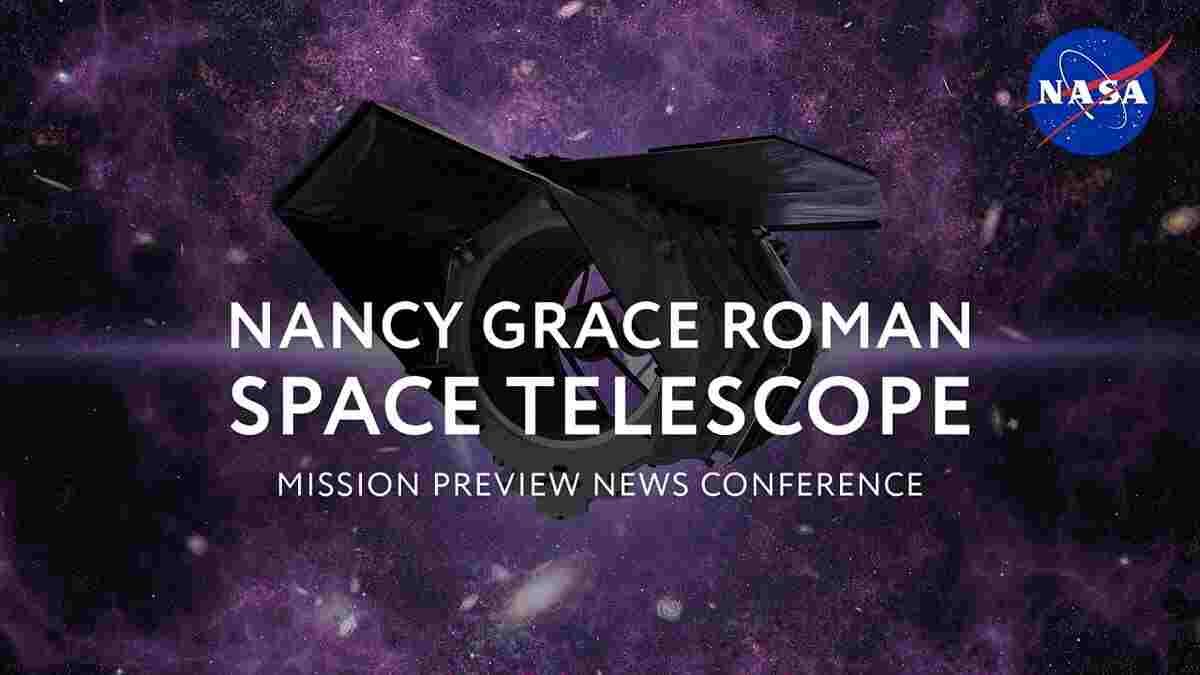
NASA’s Nancy Grace Roman Space Telescope is now making its way through the serene depths of space after a triumphant launch carried it to one of the most scientifically advantageous parking orbits in the solar system. On 30 August the space observatory launched from Launch Complex 39A at Kennedy Space Center on a SpaceX Falcon Heavy rocket, where moments later the craft separated painlessly and launched on its three-month dash to the second Sun-Earth Lagrangian point, designated simplyL2. The other target is about 1.5 million km away, in the direction opposite to that of the Sun.
In this position, the combined gravity of the Sun and the Earth is almost zero, so a craft in this position needs very little fuel to maintain a stable orbit. The James Webb Space Telescope is already at this location. Roman will occupy a fairly large, looping halo orbit about the point, far enough away that it is not affected by the neighboring craft.
It will have to share the same cold dark thermally stable environment that makes infrared astronomy possible. The telescope is named after Nancy Grace Roman, NASA’s first chief of astronomy and in many ways the mother of the Hubble Space Telescope. This seems very appropriate. After Hubble delivered a sharp-vision view of the universe, and Webb peered into the near-infrared, Roman is the broad church of space telescopes. Its 2.4 meter primary mirror is the same size as Hubble, but with its wide-field instrument, it can eye a square degree of sky more than 100 times faster in one shot.
In simple terms the observatory will see the universe 1000 times more quickly than Hubble, and see it in a sharper infrared. This speed coupled with its wide field of view make Roman Mainly well equipped to ask many of the biggest open questions in astrophysics. Its primary survey will chart the distribution of dark matter throughout the universe using weak lensing. It will chronicle the expansion of the universe driven by dark energy, and precisely image the shapes and distances of hundreds of millions of galaxies.
At the same time the telescope will be fixated on the dense heart of the galaxy and will use gravitational microlensing to search for tens of thousands of new planets including free-floating worlds drifting through interstellar space. A state-of-the-art coronagraph will also make an attempt at directly imaging planets around nearby stars by blocking out the dazzling glare of their suns. Engineers have verified that the solar panels and several primary sunshades deployed successfully.
NASA’s Deep Space Network stations smoothly relayed data during the early navigation phase as Roman receded from the home planet. NASA has started the trajectory correction burns to optimize Roman’s orbit so it will be precisely positioned for its orbital insertion at L2. The latter will mark the start of a commissioning period that will last for several weeks and will ensure the spacecraft are ready for the prime science phase. NASA has has announced that the first images will be available to the public early 2027. Roman is planned to carry out a primary mission lasting 5 years; it has sufficient fuel and margin capacity for a long duration mission lasting a similar amount of time. Much the craft was designed with the ability to be robotically refilled.