



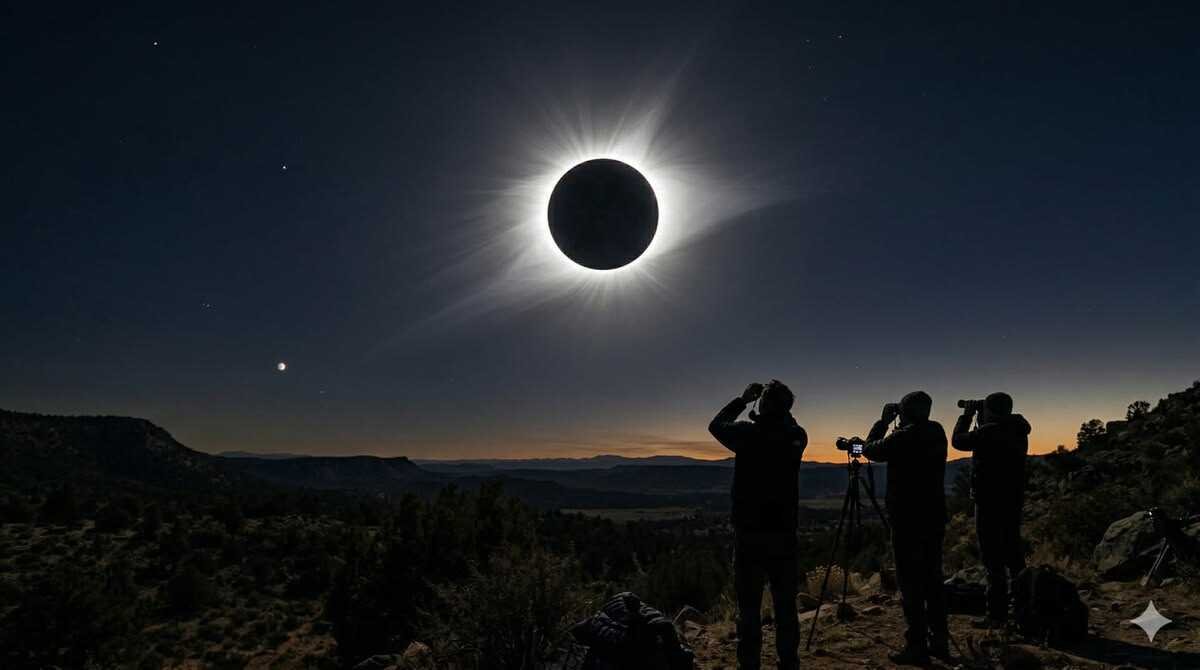
One crisp August afternoon, the moon occluded the sun and transformed the day into a strange, fleeting twilight in certain areas of Europe. In the area of totality, the sky grew dark, the temperature suffered a brief chill, the corona appeared. And for a few fleeting minutes, countless heads, having prepared for the event a month or more, or just looking up at the midday sky as usual, gazed in silence.
The total eclipse on August 12 2026 was the first to track across the continents of Europe for over twenty years. The narrow swathe started just off the southern tip of Siberia, swept across Greenland and Iceland, then crossed the north of Spain before finally disappearing into the Mediterranean at sunset. Within the traverse of totality, the sun was totally obscured for as much as two minutes.
Elsewhere, from Great Britain to central Europe and across parts of North Africa, the moon would heavily shadow the sun’s disk, producing a significant deep partial eclipse that still changed the waters of the world. Crowds assembled on beaches, atop hills, in city squares and in the empty greens of country villages. In Spain, where the entire phase arrived so late in the afternoon as the sun dipped near the horizon, the shadows and surreal glow from the landscape made Most of all vivid photographs. Families spread out picnic blankets, photographers perched along the remains of long-ago wall and along the sleek contours of the modern waterfront. Those watching through bluenosecertified eclipse glasses, those through crafty cardboard pinholeros or common kitchen colanders.
Cheers rippled through those who saw the eclipse to totality, and then the darkening murmured to a hush as the glow of the corona flickered. The images that appeared just hours after told a story both scientific and human. Photographers in Iceland to the Spanish coast documented the diamond ring thing as the final drop of sun dropped away and the translucent white streamers of the corona appeared and the odd bluish twilight brushed over familiar structures. Cathedrals, castles and seaside towns sat darkened below the moon blocking the sun. In metropolises outside the totality zone, citizens stood in the streets and on rooftops observing the world grow dimmer and the air cooler. To many the event was a communal experience of the uncommon.
Weather in places along the eclipse path cooperated perfectly, while clouds and smoke from wildfires obscured the scene in others. Still the eclipse was something we all experienced together. Hotels along the path were fully booked for weeks prior. Vendors rented out glasses and places to stand. Researchers, professional and amateur alike, experienced the eclipse not just as a wonder of nature, but as an opportunity to examine the outer temperature of the sun under optimal conditions.