





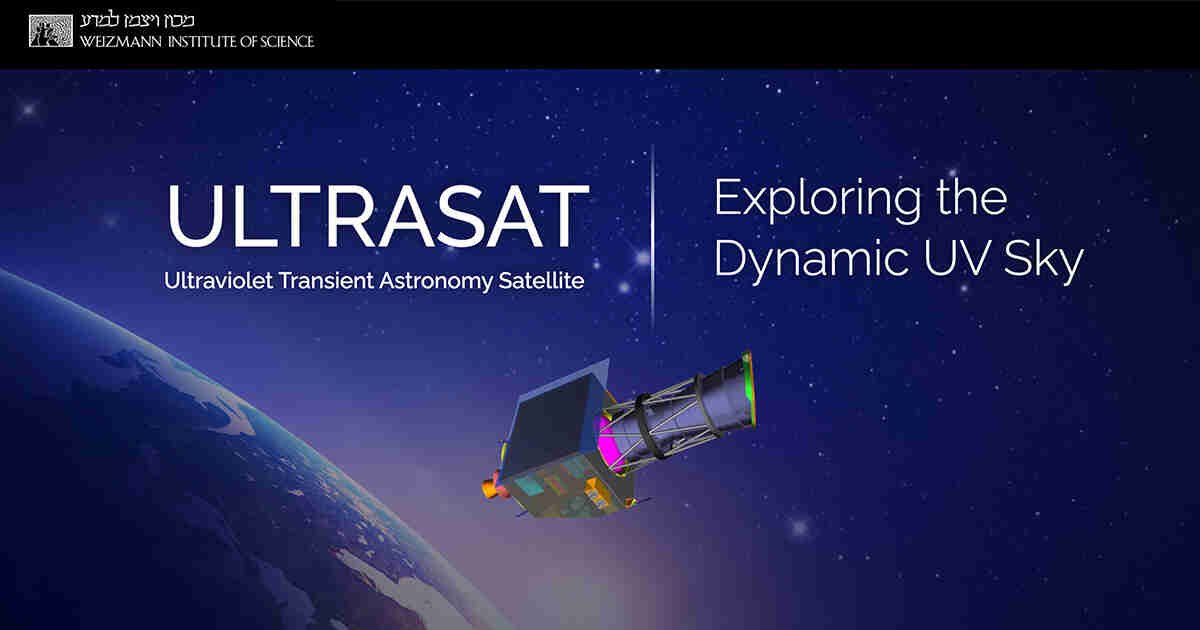
The global scientific community is gearing up for one of the most exciting space science missions in recent years as ULTRASAT, the Ultraviolet Transient Astronomy Satellite, prepares for launch. This groundbreaking space telescope — the first of its kind built as a small satellite with a remarkably wide view of the sky — is slated to be sent into a high orbit in early 2026 as part of an international collaboration that includes NASA and the Weizmann Institute of Science in Israel.
ULTRASAT is designed to open an entirely new window on the dynamic universe by operating in the near-ultraviolet (NUV) part of the electromagnetic spectrum — a range of light that is mostly blocked by Earth’s atmosphere and has been difficult to observe in detail until now. The mission’s core innovation lies in its extremely large field of view of 204 square degrees, enabling it to monitor vast swaths of the sky simultaneously — far more than traditional UV telescopes like GALEX could achieve.
A New Era for Detecting Cosmic Transients
Traditional telescopes often focus on narrow patches of sky, but ULTRASAT’s design allows it to continuously scan a much broader region. This capability is crucial for observing transient cosmic events — short-lived, explosive phenomena that include supernovae explosions, neutron star mergers, and other dramatic changes in the night sky. These fast-moving events emit flashes of ultraviolet light that can disappear in minutes to days, making them hard to catch unless you have a telescope with a rapid-response wide field of view.
One of ULTRASAT’s most anticipated contributions is to multi-messenger astronomy, which combines data from different signals — like gravitational waves and electromagnetic radiation — to build a more complete understanding of cosmic events. For instance, when gravitational wave detectors pick up the signature of two neutron stars colliding, ULTRASAT will be uniquely positioned to swoop in and identify the ultraviolet light from that event. These observations can reveal crucial insights into the physics behind such collisions and the origin of heavy elements in the universe.
Real-Time Alerts and Global Collaboration
Beyond just capturing images, ULTRASAT is engineered to send real-time alerts to astronomers worldwide whenever it detects a transient event. These alerts will trigger follow-up observations from both ground and space-based observatories, enabling scientists to study phenomena across the electromagnetic spectrum. This rapid, coordinated response will dramatically improve our ability to track the cosmos’s most ephemeral events.
The mission is notable not only for its scientific goals but also for its international collaboration. Built by a consortium including Israel Aerospace Industries (IAI), Elbit Systems, and the German DESY institute, ULTRASAT represents a powerful partnership between cutting-edge research institutions and space agencies. NASA’s role includes providing the launch and contributing to science leadership and data distribution.
Launch Timeline and Scientific Legacy
Although some recent mission updates suggest planning into 2027, multiple announcements still point to an early-2026 launch window, making this project one of the most anticipated space missions in the near term. Once deployed into a geostationary orbit, ULTRASAT will begin its prime three-year science mission — with potential extensions if systems perform well.
When operational, ULTRASAT will transform not only our view of ultraviolet skies but also deepen our understanding of how stars explode, how black holes interact with their surroundings, and how gravitational waves and light interplay in extreme cosmic environments. This mission marks a major milestone in space science and sets the stage for a new era of discovery — reminding the world that even relatively small satellites can produce big breakthroughs.


