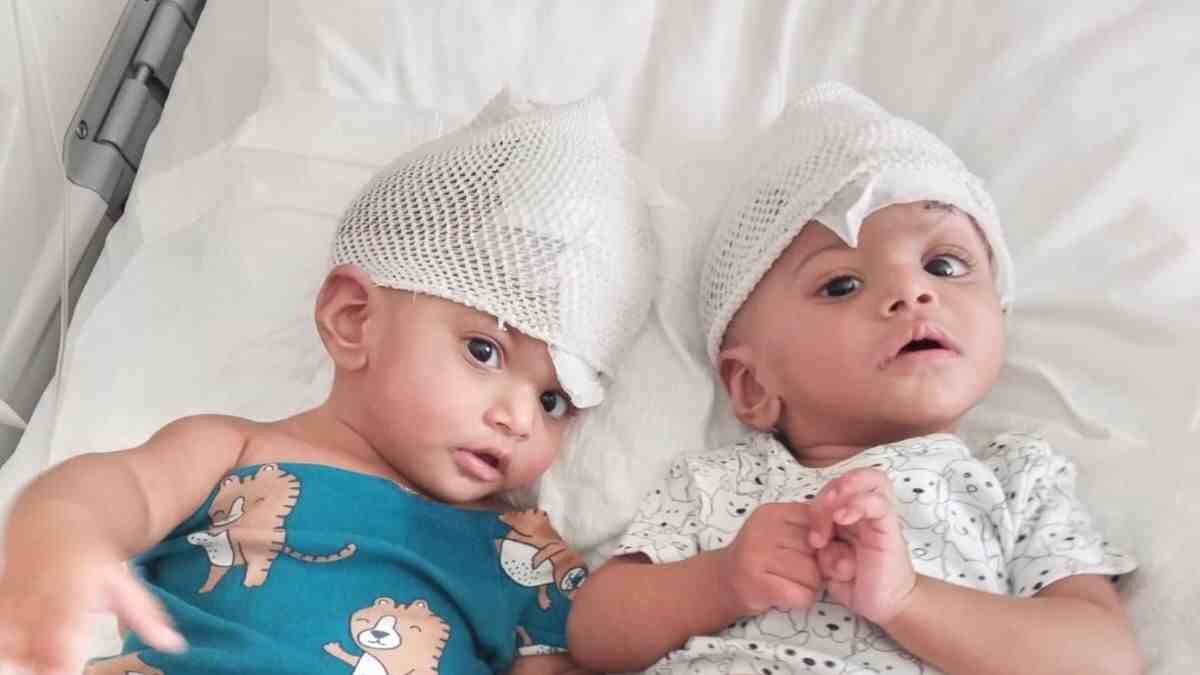
Fijian conjoined twins Jesepeli (L) and Dicecea Kikau stand with their father during a press conference at King Abdullah Specialist Children’s Hospital in Riyadh, Saudi Arabia. AFP/Handout photo SHOWS: RIYADH, SAUDI ARABIA 13-month-old Fijian conjoined twins Jesepeli and Dicecea Kikau have been separated after a gruelling 13-hour operation in Saudi Arabia. The highly specialised surgical team took the twins apart at the King Abdullah Specialist Children’s Hospital in Riyadh, a first for the sisters and their family after months of medical evaluations.
The operation took place on 15 October 2026 via the Saudi Conjoined Twins Program. It was led by paediatric surgeon Dr Abdullah Al-Rabeeah and involved 34 doctors, including surgeons, anaesthetists, nurses, and specialists from various surgical fields.
The sisters were born joined at the lower abdomen and pelvis, due to a rare condition called omphalo-ischiopagus tetrapus. Despite each of them having their own lungs and heart, they shared many key organs.
These tests uncovered common parts of the liver intestines colon, reproductive, and urinary system and sections of the pelvic bone. The surgeons carefully worked out how they could take apart the many structures to keep both children’s organs working and prevent the risk of any potentially life-threatening complications.
The team split up the operation into nine steps: the separation of shared organs and tissues and the delicate separation and reconstruction of blood vessels and other anatomy so that each baby could be treated on its own.
The doctors said the separation was successful and the operation went more smoothly than anticipated in the early stages. The reconstruction of the twins occurred after the significant separation. As the twins go through recovery, they will be under specialist supervision.
After the family obtained treatment from overseas, in July 2026, the twins and their parents flew to Saudi Arabia. They then underwent various investigations to see if separation would be possible and for them to develop the safest surgical plan.
The family hit a major financial roadblock when they learned that estimates to fund treatment in a number of other countries were out of their reach. The Saudi Conjoined Twins Program was able to provide the operation free of charge by developing the specialised care through its humanitarian program.
The programme also has extensive experience in a rare form of conjoined twin separation. Saudi reports said the operation marked the 74th separation carried out by the programme, which has evaluated 159 cases involving children from 28 countries on five continents.
This is mainly true for cases involving shared organs, complex blood supplies and large reconstruction work, with the multi-disciplinary team having a key role.
The operation came after months of uncertainty for the twins’ parents. They had to travel long distances from home, attend numerous appointments and ready themselves for a high-risk surgery.
The girls have a triplet sister Hossana (born without any conjoinment) too. The family’s triplet story meant that their life was already highly demanding, and the sisters’ separation offered them the hope of a different life.
Before surgery, the parents decided the twins’ names in Arabic Noorah for Jesepeli, Sarah for Dicecea as they underwent treatment in Saudi Arabia. The twins’ story made headlines in Fiji, where a publicly documented case of siamese twins is almost unheard of.