



Once again, the capabilities of NASA’s James Webb Space Telescope (JWST) have led to a major expansion on humanity’s knowledge about the universe, this time by unveiling a unique view revealing a super massive black hole actively swallowing surrounding matter. These most recent findings give great value to astronomers and offer them an opportunity to dive deeper into understanding one of the universe’s most energetic and mysterious things, as well as to get a very clear and detailed idea on how such huge black holes actually grow and how they affect on a large scale the evolution process of their host galaxies.
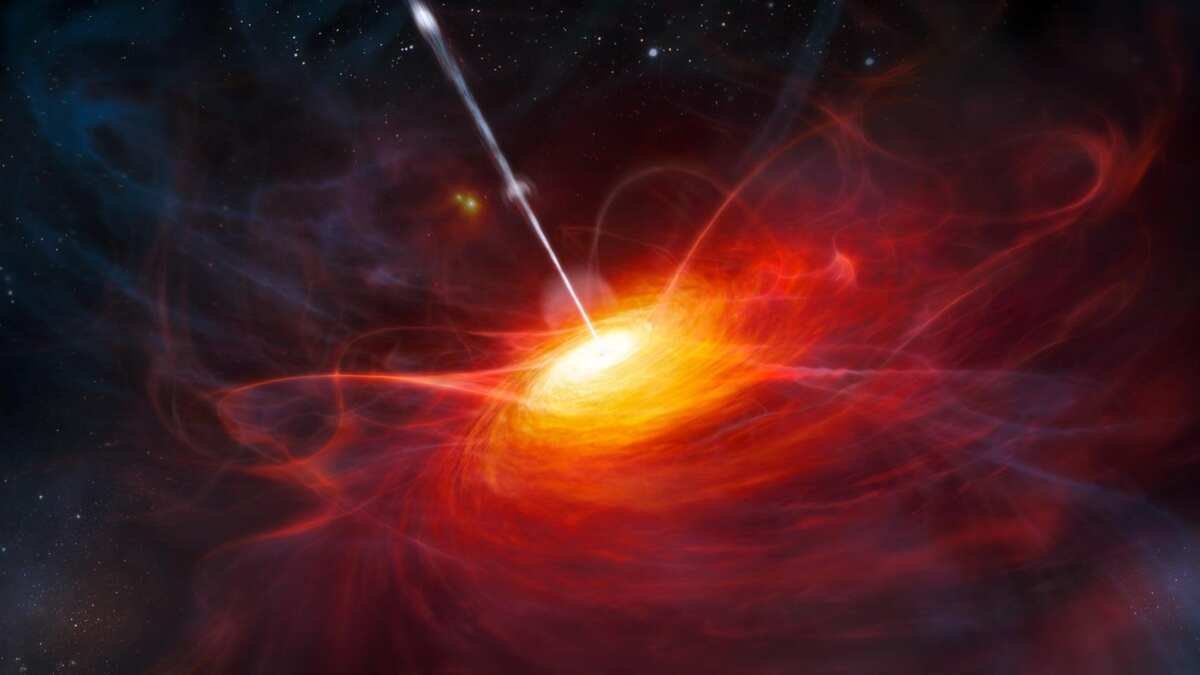
It is now commonly accepted that supermassive black holes are present in the heart of almost every large galaxy in the cosmos including the Milky Way itself. Differentiated from black holes created out of star collapses these massive objects are so heavy that some might even have millions or trillions of solar masses worth of materials in them. Since black holes in themselves cannot emit light which makes them impossible to be observed directly as the strength of their gravity prevents even a single photon from escaping, what scientists do is to look at the huge amount of energy radiating when gas, dust and other objects get close enough to the black hole and start spiraling before reaching the event horizon.
The superb infrared capability provided by James Webb Space Telescope’s sophisticated instruments has allowed scientists to observe this consumption event quite clearly in a way never possible before.
The newly observed food source demonstrates that a great number of gas clouds together with dust grains are getting sucked towards the super black hole in question, As the gravitational pull of the black hole gets stronger the material gets more tightly packed and starts to rotate rapidly. From the friction that arises between these packed up materials, they get superheated and emit lots of radiations at very short distances before they finally get swallowed by the black hole.
The study points to this activity being an active black hole growth process as well, which may account in part for the fact of the evolution process of galaxies. Not only that but when a black hole feeds, the surrounding area is also affected. Powerful jet streams with high-speed matter accompanied by radiative energy from such events can influence or actually control star formation activities in galaxies. It appears the term for such mechanism in astrophysics is ‘galactic feedback’ and such processes might be one way galaxy development regulation is carried out by controlling the movement and heating-up of inter galaxy gas through billions of time scales.
One of the great advantages that the James Webb telescope has over the rest of the observing satellites is In reality it is one of the most sensitive detectors of its kind on an international scale. The telescopes are capable in some extent of picking up the very faint infrared signals and from galaxies that are so far away it is equivalent only being able to look backwards billions of years to what time those distant worlds would be representing now, that the telescopes are seeing then.
At the end of the observation cycle, these latest findings of course have shed some light on the interaction between the supermassive black holes with the galaxy itself. Over the many years since scientists started using telescopes to look up at the starry skies, these have shown us that in general, larger galaxies have larger black holes at their centres. Unveiling more about the black holes that result from feeding processes may then throw light on the connection of this thing between the black hole and the galaxies that surround them.
One of the major trends in modern astronomy is combining data collected simultaneously from multiple telescope facilities. Though for instance the James Webb Space Telescope is a top-tier one when it comes to observing infrared light, scientists often compare data from other types of telescopes with findings from this one as well. In fact, X-ray telescopes, radio telescopes and visible light telescopes help make possible a more comprehensive view of the complex physical processes unfolding inside the proximity of black holes by giving information each about a piece of the whole picture.